Arctic Frontiers 2026 was shaped by the evolving security situation in the Arctic and discussions on how research is affected by – and contributes to – this changing geopolitical context. From high-level political leaders, including Norway’s Prime Minister Jonas Gahr Støre and European Commission Vice-President Kaja Kallas, to individual research projects, the Arctic’s strategic importance was clearly at the forefront.
Several policy-oriented sessions addressed issues directly relevant to Polar Connect, such as subsea cables and the future research icebreaker fleet. A clear takeaway was that change in the Arctic is rapid and that research infrastructure is increasingly viewed through a geopolitical lens.
From seabed to space – Polar Connect in the Ocean Observational Pyramid
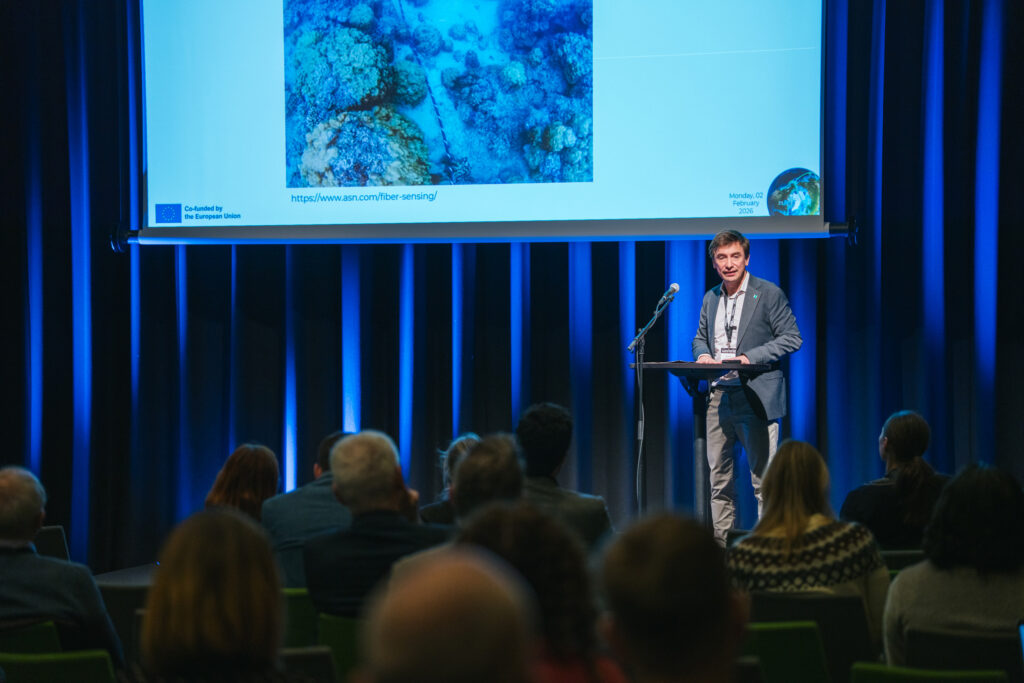
The growing demand for long-term monitoring and new observatories in the Arctic Ocean was a central theme at the session “Ocean Observational Pyramid: From Seabed to Space Monitoring.” Experts discussed how future systems can connect seabed sensing with satellite-based monitoring into a coherent, end-to-end observing capability.
Ulf Jonsell, Swedish Polar Research Secretariat, presented “Polar Connect – An Arctic Observing System through Fiber Optics,” arguing that fiber-optic infrastructure can provide the missing backbone linking sensors, reliable data transmission, and sustained operations over time.
– Polar Connect can function as a backbone for Arctic observations, where the fiber not only carries data but also creates new opportunities for sensing and scientific data collection along the seabed in international waters. It could therefore become a key building block in a distributed Arctic observing system, says Ulf Jonsell.
However, a major obstacle remains: there is currently no international mechanism able to genuinely coordinate initiatives or mobilise substantial joint infrastructure investments at scale.
– There is reason to compare this with major international telescope projects, where nations jointly build the core infrastructure. That should be possible in the Arctic as well – even if the infrastructure, by nature, must be distributed rather than located at a single site, says Ulf Jonsell.
Beyond its scientific potential, Polar Connect is a pathfinding initiative to establish robust infrastructure across the Arctic. By creating a secure fiber optic route through high-latitude waters, the project would strengthen global network resilience.
Subsea cables in a security perspective
In the current security climate, concerns are sometimes raised that an Arctic fiber-optic cable would be vulnerable to sabotage. Yet extensive subsea cable infrastructure already operates in regions with far more complex security environments. The key question is therefore not whether such infrastructure is needed – global digital communication depends on fiber-optic connectivity – but how it can be designed to be secure, resilient, and capable of supporting environmental monitoring as part of a multi-purpose system.
Research icebreakers and Arctic presence
Discussions at Arctic Frontiers also reinforced the importance of strong research icebreaker capacity. A modern fleet is essential for advanced science, the deployment and maintenance of subsea infrastructure, and for maintaining presence in support of tasks such as search and rescue.
Arctic Frontiers 2026 illustrated that the Arctic is being redefined – scientifically, politically, and strategically. As global actors reassess the strategic value of northern corridors that are less exposed to geopolitical tension or infrastructural bottlenecks, Polar Connect has a clear role in shaping the future of Arctic cooperation and knowledge generation at the intersection of digital infrastructure, environmental monitoring, and geopolitics.